Light of Time – Hu Jieming – Jigsaw Puzzle of Memory.(11.11, 2016 ).


reference:Shanghai zhengdan museums. Auroramuseum.Cn, http://www.auroramuseum.cn/en/aurora/exhibit/special_detail.html. Accessed 6 Dec. 2023.
purpose: Hu Jieming’s works let me learn how to express time and how to materialize time. It also made me think that in time I can choose to draw the city’s table to express time.
SUMMARY: Hu Jieming has long focused on “time” as a theme for his creations. He utilizes a variety of media to create his works. In the Paradise Series, he utilizes the history and memory of the city to create works that search for the unchanging values of the past. The source of his creation is the change of time, space, history and memory. The works as a whole create an artistic field of aurora flux, where the artist’s memory puzzle evokes the audience’s resonance, touch, and participation, and extends the spirit of creation through the flow of the light of time.
Qutoes: Hu Jieming says that he himself is borrowing the flow of the light of time to create a jigsaw puzzle of the city’s memory.
connection:Hu Jieming is not limited to the beauty of traditional art, his innovation is very bold, he uses painting and installation art area to show the time he wants. He puts the paintings together as if he were putting them together as a jigsaw puzzle of memories. His colors and creations will touch the viewer and may make the viewer to participate in this time. His transparent and colorful paintings on the windows also triggered me to think about what to do with the two windows in my exhibition.
Either way, you’ll be in a pool of something, 2015,ruby onyinyechi amanze.Ruby onyinyechi amanze: Drawing the Elements, Choreographing Freedom
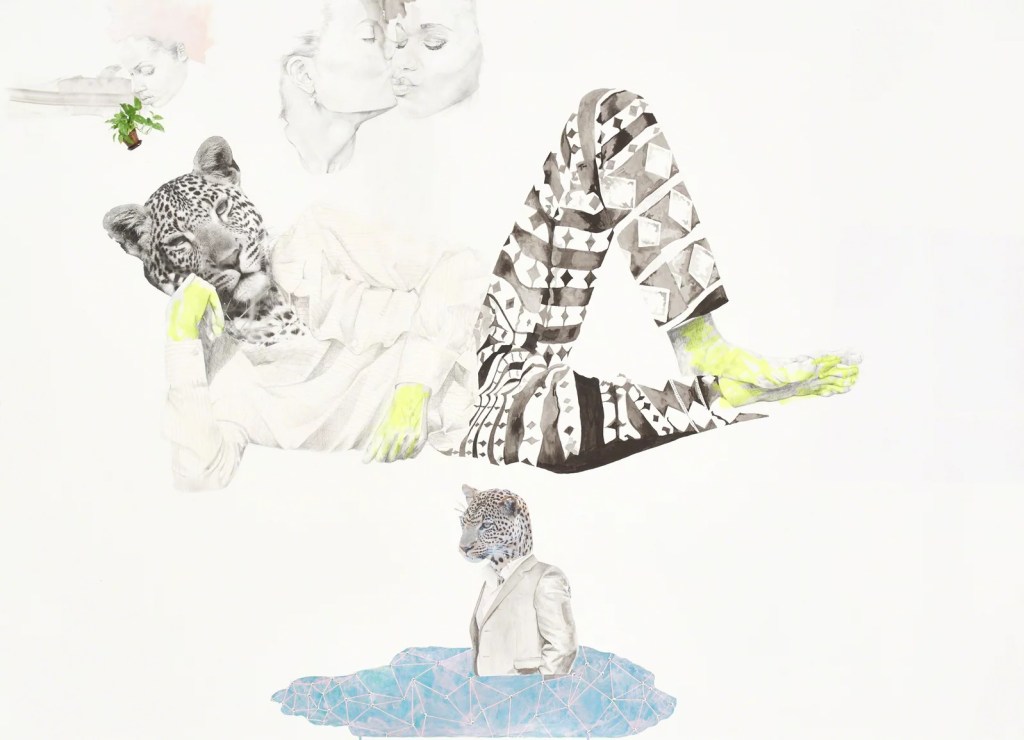
reference: Ruby Onyinyechi Amanze. “Either way, you’ll be in a pool of something.” In Ruby Onyinyechi Amanze: Drawing the Elements, Choreographing Freedom (2015).
purpose: Ruby’s work has made me learn and think about how animals can be better combined with the human body. How to make the combination of the two less jarring.
SUMMARY: ruby most of her drawings consist of aliens, leopards, birds, and more. She places all these animals and characters in different stories and scenes. She is constantly innovating and utilizing dance, architecture, etc. to draw floor plans and then to express what she understands and thinks of as space. Bodies in space and buildings in space. As someone who works in a predominantly two-dimensional drawing form, she is drawn to the three-dimensionality of dance and architecture, rooting their connection in the shared process of creating space.
Qutoes: She reflects, “As an immigrant, I am thinking about home and what it means to make a home for myself on paper.
connection:The nature of her quest for free flow and her statement that she feels memories, trauma, and joy all become infinite possibilities because of the fluidity of water. In her interview, it made me want my river to show freedom. Her understanding of space also helped to inspire me in the subsequent creation of my work. Because what I need to create many stories within time. I also needed to create space on the water. And how the movement of the animals in her paintings came to be gave me a lot of ideas.
ruby onyinyechi amanze She has done a lot of paintings that look like collages of general animal heads combined with human bodies. She puts some interesting movements on the animals. And put sweatpants on them. From her work I need to learn how to draw action vividly. This will make the historical animals in my work appear less stereotypical. Or I could learn how to make collages. I could draw many sets of movements and then collage the heads of the animals I draw with the movements I draw. This way my animals will not have only one action, but many sets of actions that can be replaced. Or, I could draw many sets of clothes so that I could also replace them on each of the animals instead of just a single one.
Bohemia Lies by the Sea by Anselm Kiefer, 1996.

reference:“Anselm Kiefer.” The Metropolitan Museum of Art, https://www.metmuseum.org/art/collection/search/486996. Accessed 6 Dec. 2023.
purpose: The materials of Anselm Kiefe’s work inspired me to think about how to make the viewer experience the change of time. How to use different materials to express it.
SUMMARY: In Anselm Kiefe’s Bohemia Lies by the Sea, he turns the paint applied to the canvas into something that naturally flakes off over time. This effect occurs because he turns the paint, which was originally applied flat, into a very thick paint. Thus the paint itself becomes time, and he visualizes time. The stacking of multiple layers of history and media is one of his signature creations. He will also add broken glass or dried flowers, etc., so that these physical layers witness the meaning of time and become the sediment of history.
Qutoes: He said, “As an artist, I believe it is possible to depict these forces. I am against the idea of finality, that everything ends in heaven or judgment. Art is really hard, it’s hard to make and sometimes it’s hard for the audience to understand. It’s hard to figure out what is art and what isn’t. There are only a few people who can talk about art, which is very limited. When I see a new artist, I give myself a lot of time to think and decide if it’s art or not.”
connection:His ability to take something that cannot be shown or seen and make it visible to the viewer is something I should reflect on. His work has also inspired me on how to immerse my audience in my work. To make the impossible possible. A lot of artists’ works are concerned with painting skills and aesthetics, etc. But his work made me think. But his work made me think that it is an interesting phenomenon if we create the painting at the beginning and then let the painting play freely by itself. Because no one knows what will become of the work in the future. This can also represent time.
Alphonse Maria Mucha

reference: “The Seasons (Spring, Summer), 1898 – Alphonse Mucha – Wikiart.org.” Www.wikiart.org, https://www.wikiart.org/en/alphonse-mucha/the-seasons-spring-summer-1898. Accessed 6 Dec. 2023.
purpose: I consider Mucha to be the originator of characters and cartoons. I have learned so much from his works, and his works let me learn how characters become delicate lines are drawn cleanly.
SUMMARY: First of all, one of Muxia’s stylistic characteristics is the beautiful and smooth lines. His works are full of curves and natural lines, and this elegant line fluidity makes his works full of dynamism and vitality. Mucha is adept at using organic shapes and botanical motifs to create an elegant and rhythmic visual effect. His lines are not just decorative elements, they are a unique expression of his work, conveying his love for nature and the beauty of life.
Secondly, Mucha’s use of color is outstanding. He uses vivid colors and rich tones to create dramatic effects. Moussia often uses soft and full colors, and through contrasts and gradations, he makes the images full of layers and three-dimensionality. He is adept at using bright colors to emphasize the subject matter, and at the same time expresses emotion and atmosphere through the use of color, creating a strong visual impact on the viewer.
Qutoes: “I don’t expect to bring myself wealth, comfort or fame. I just want to have the opportunity to create more valuable work.” — Mucha,1904.
connection: Muxia is also very attentive to details. He focuses on the delicacy and realism of details, especially in the depiction of female figures. His female figures usually have soft and elegant curves with gentle and subtle facial expressions. He is good at capturing the softness of women and conveying their tenderness and inner strength through meticulous expressions and gestures. This delicate painting technique makes his works more intimate and attractive.
I can combine the figures with some of the starry sky elements I want to paint or combine nature into the picture I need to express time. For example, flowers wilting or so on.
 SHUWEN